

Jo Keirns
42 min read

Founded in 1998, Living Tree Company began with natural health, holistic living, and the wisdom of the Tree of Life. Today, it offers a welcoming space for wellness, emotional healing, relationship insight, romance scam awareness, safety, resilience, and understanding human behavior.
This space brings together natural wellness, holistic living, emotional awareness, relationship insight, personal safety, resilience, and a deeper exploration of the mind, heart, and human behavior.
Wellness is viewed here as more than physical health. It includes the roots beneath our choices, the stories people carry, the relationships that shape growth, and the wisdom gained through healing, self-protection, awareness, and change.
I write from a place of curiosity, lived experience, and care. Living Tree Company is not about quick fixes or surface answers. It is about noticing patterns, asking deeper questions, and helping readers feel more informed, more protected, and more connected to their own inner wisdom.
Join me for thoughtful articles on holistic wellness, mental health, emotional healing, relationship safety, romance scam awareness, and the psychology of human behavior.
Text: Join me for thoughtful articles on holistic wellness, mental health, emotional healing, relationship safety, romance scam awareness, and the psychology of human behavior.
Subscribe or Join the Newsletter
Recent Posts


Archive
Tags

Autumn arrives with a particular kind of wisdom. It does not rush into the world with the bright urgency of spring or the full-throated abundance of summer. Instead, it softens the edges of the day. It lowers the sun, cools the air, and turns the trees into a language of release. Leaves loosen their grip not because they have failed, but because the season has changed. In that simple, visible surrender, autumn offers one of the most compassionate lessons nature can give: there is a time to bloom, a time to hold, and a time to gently let go.
For many people, autumn is beautiful, but it can also be busy. Work schedules intensify after summer. School calendars return. Holidays begin to appear on the horizon. Daylight shortens, and the mind may feel a quiet pressure to accomplish more before the year ends. Even the body notices the transition: cooler mornings, darker evenings, thicker clothing, and the subtle instinct to turn inward. If you have been feeling scattered, tired, overstimulated, or emotionally full, autumn can become more than a backdrop. It can become a practice.
This blog post is an invitation to experience autumn as a moving meditation. You do not need a silent retreat, a perfect forest, special equipment, or a completely calm mind. You only need a willingness to pause and notice what the season is already showing you. The sound of dry leaves underfoot can become a grounding rhythm. The smell of damp soil can bring you back into your body. A tree releasing its leaves can become a mirror for worries you are ready to set down. A cool breeze can remind you that breath is always arriving, always leaving, always beginning again.
Research on nature exposure and forest bathing suggests that time in natural environments can support stress reduction, ease anxiety, and improve mood, especially when the experience is slow, sensory, and intentional. Autumn is particularly suited to this kind of practice because it naturally invites attention. It gives the senses so much to meet: color, texture, fragrance, temperature, light, sound, and motion. When we let the season guide us, nature becomes less like scenery and more like a steady companion.
Stress often pulls attention away from the present moment. The mind revisits unfinished conversations, future deadlines, family responsibilities, financial concerns, health worries, and the many small obligations that collect throughout the day. When stress becomes chronic, the body may remain on alert even when no immediate danger is present. This state can feel like tight shoulders, shallow breathing, racing thoughts, irritability, mental fog, or a sense that rest is always just out of reach.
Nature offers a different pace. Unlike a screen or a crowded schedule, a natural setting rarely demands immediate reaction. It invites a softer form of attention: watching clouds move, noticing birds cross the sky, following the path of a leaf as it falls. This kind of attention is restorative because it does not require force. You are not solving, proving, comparing, or performing. You are simply receiving. The nervous system can begin to recognize that, in this moment, there is room to exhale.
Autumn deepens this restoration because it is a season of visible transition. In spring, change often looks like effort: buds pushing open, roots drinking deeply, green life rising fast. In autumn, change looks like release. Trees do not argue with the light. Fields do not cling to their summer fullness. The garden does not apologize for resting. Everything seems to say, “Enough has been done. Now let the next rhythm come.” For a stressed mind, this can be profoundly reassuring.
When you spend time outside in autumn, try not to treat nature as an item on your wellness checklist. Let it be a relationship. You are not going outdoors to force calm or criticize yourself for feeling anxious. You are going outdoors to be met by something larger, older, and more patient than the pressure in your thoughts. The maple does not ask you to have everything figured out. The wind does not require you to be productive. The geese overhead do not evaluate whether you are meditating correctly. Nature simply offers presence, and presence is often the beginning of peace.
“Everybody needs beauty as well as bread, places to play in and pray in, where Nature may heal and cheer and give strength to body and soul alike.” — John Muir
You can practice autumn meditation almost anywhere: a forest path, a neighborhood sidewalk, a park bench, a garden, a porch, a window overlooking trees, or even beside a single potted mum on a balcony. The power of the practice is not in the grandeur of the location. It is in the quality of your attention. A single leaf can become enough if you are truly present with it.
Before you begin, choose a place where you can be reasonably safe and undisturbed. Dress for the weather so your body feels supported rather than distracted. If it is chilly, bring a warm layer. If the ground is damp, sit on a folded blanket or simply stand. Silence your phone if you can, or place it on do not disturb. If you are walking, let the walk be slow enough that you can feel each step rather than using the time to rush toward a destination.
Set an intention, but keep it gentle. Instead of saying, “I must relax,” you might say, “I am here to listen,” or “I am willing to soften,” or “For the next little while, I will let autumn teach me.” Intentions work best when they open a door rather than create another expectation. If your mind wanders, that does not mean you have failed. Wandering is what minds do. Returning is the meditation.
“To affect the quality of the day, that is the highest of arts.” — Henry David Thoreau
You may want to begin with a simple grounding ritual. Stand or sit comfortably. Let your shoulders drop away from your ears. Notice the contact between your feet and the earth, floor, or path beneath you. Take three slow breaths. On the inhale, imagine you are receiving the clean, cool air of the season. On the exhale, imagine you are releasing a little of what you have been carrying. You do not have to release everything. Even a small softening matters.
One of the simplest ways to enjoy nature and reduce stress is to move through the senses one by one. Stress often traps us in thought, but the senses return us to direct experience. What you see, hear, smell, touch, and taste belongs to the present moment. The senses do not replay yesterday or rehearse tomorrow. They say, “Here. Now. This.”
Begin by looking around without naming too quickly. Instead of simply thinking “tree,” “leaf,” or “sky,” notice qualities: amber, rust, gold, burgundy, moss, shadow, silver cloud, pale grass, dark branch. Let your eyes wander slowly. You might choose one tree and study its many colors. You might notice that one leaf contains several seasons at once: green still holding on near the stem, yellow spreading from the center, brown curling along the edges. This kind of looking slows the mind because it asks for attention rather than analysis.
Imagine that every color you see has a quality your body can receive. Gold offers warmth. Red offers vitality. Brown offers steadiness. Gray offers rest. Green offers continuity. As you look, allow your breathing to match the landscape. Inhale the colors that nourish you. Exhale the tension that no longer needs to be held so tightly. Let your eyes become soft. Let seeing become a way of being soothed.
Close your eyes if it feels safe, or lower your gaze. Listen first for the obvious sounds: leaves scraping along pavement, branches clicking, birds calling, distant traffic, a dog barking, your own clothing shifting as you breathe. Then listen underneath those sounds. Notice the pauses. Notice how no sound lasts forever. Even noise moves through space and changes. You may discover that listening does not require you to judge what you hear. It only asks you to receive.
If your thoughts are loud, let the outer sounds hold them. You might imagine each sound as a ripple on a pond. A car passes: ripple. A crow calls: ripple. A leaf lands: ripple. A thought rises: ripple. Nothing has to be grabbed or pushed away. Everything comes, moves, and fades. The more you listen this way, the more you may sense that your mind does not have to be perfectly quiet in order for you to experience calm.
Autumn has a scent unlike any other season. It may smell like fallen leaves, rain on soil, woodsmoke in the distance, apples, pine needles, cold air, or the faint sweetness of decay returning to the earth. Take a gentle breath in through your nose. Do not strain. Let the scent arrive. Smell connects strongly with memory, so you may notice images from childhood, old walks, family gatherings, or quiet evenings from years ago. If memories arise, meet them kindly and return to the breath.
With each inhale, imagine the earth itself offering stability. The soil has received every fallen leaf, every spent flower, every season’s ending, and transformed it into nourishment. Let that become your reminder: what falls apart in life is not always wasted. What you release may become compost for wisdom, patience, and future growth.
Touch is grounding because it brings awareness into the body. Place your hand on your heart, your coat sleeve, a tree trunk, a smooth stone, or the bench beneath you. Notice texture and temperature. The bark may be rough. The air may be cool against your cheeks. A leaf may feel dry and delicate between your fingers. Your own hands may feel warm inside your pockets. Let these sensations remind you that you are not only a thinking mind. You are a living body in contact with a living world.
If you are walking, bring attention to your feet. Feel heel, sole, toe. Notice the shift of weight. Imagine the ground answering each step, not with words, but with support. You do not have to carry yourself alone. The earth has been holding you all along.
Taste may seem less obvious outdoors, but it can still be part of autumn meditation. You might bring a warm cup of tea, apple cider, or water. Before drinking, pause. Notice the warmth or coolness, the scent, the small anticipation before the first sip. Taste slowly. Let the act of drinking become a ceremony of receiving. If you do not have anything with you, simply notice the taste of the air, the freshness after rain, or the way breath feels in the mouth.
Savoring interrupts urgency. It teaches the body that not every moment has to be consumed quickly. Some moments are meant to be tasted. Autumn, with its orchards, soups, spices, and warm drinks, knows this well. It invites us to linger.
“Autumn is a second spring when every leaf is a flower.” — Albert Camus, commonly quoted from The Misunderstanding
The following visualization can be practiced outdoors beneath a tree, indoors by a window, or anywhere you can comfortably close your eyes for a few minutes. Read through it slowly, or record it in your own voice and play it back. If at any point the imagery does not feel right, adapt it. The most healing visualization is not the one performed perfectly, but the one that helps you feel safe, present, and connected.
Sit or stand in a comfortable position. Allow your spine to be upright but not stiff. Let your hands rest easily. Take a slow breath in, and imagine that the air entering your body is clear and cool. Take a slow breath out, and imagine your exhale leaving as a faint mist, carrying away a thin layer of tension.
Now picture yourself standing in a quiet autumn grove. The trees around you are tall and generous. Their leaves glow in shades of gold, copper, crimson, and deep orange. Sunlight filters through the branches in long, gentle beams. The ground beneath your feet is covered with fallen leaves, soft enough to receive each step. The air is cool, but not harsh. It is the kind of coolness that wakes you up without asking anything from you.
As you breathe, one golden leaf catches your attention. It is still attached to a branch, moving slightly in the breeze. This leaf represents something you have been carrying: a worry, a responsibility, a regret, a fear, a pressure to be perfect, or an old story about who you must be. You do not need to force the leaf to fall. You simply notice it. You acknowledge it. You may silently say, “I see what I have been carrying.”
The breeze strengthens, not violently, but kindly. The leaf trembles. The branch does not cling. The tree does not panic. In its own time, the leaf releases. Watch it drift downward. It turns once, twice, catching light as it falls. As it descends, imagine the tension connected with that worry leaving your body. Perhaps your jaw loosens. Perhaps your shoulders soften. Perhaps your stomach unclenches. Let the leaf carry only what you are ready to release today.
The leaf lands on the earth. The soil receives it without judgment. It does not ask why the leaf fell. It does not compare it to other leaves. It simply makes room. Imagine the earth beneath you receiving your released burden in the same way. Nothing is wasted. Over time, what you release will be transformed into something you may not yet understand: compassion, humility, clarity, courage, or rest.
Now look around your imagined grove. More leaves are falling, each in its own rhythm. Some fall quickly. Some hover. Some remain on the branches a little longer. This is important. You do not have to let go of everything at once. Healing is seasonal. Release is allowed to be gradual. You can trust the timing of your own heart.
When you are ready, bring attention back to your breathing. Feel the ground beneath you. Sense the space around your body. Take one more inhale and imagine drawing in golden light from the grove. Take one more exhale and let your body settle. You may finish by placing a hand over your heart and saying, “I release what I can. I receive what I need. I belong to the rhythm of renewal.”
Walking meditation is one of the most accessible ways to combine nature and stress relief. Unlike seated meditation, it gives restless energy a place to go. If you have been sitting at a desk, worrying in the car, or moving through the day on autopilot, mindful walking can help your mind and body become friends again.
Begin slowly. Let your first few steps be deliberately unhurried. Feel one foot lift, move, and return to the ground. Then the other. You might silently repeat, “Arriving,” with one step and “Here,” with the next. Or try, “Breathing in,” and “Breathing out.” If you are walking through fallen leaves, let their sound become part of the practice. Each crunch can be a small bell calling you back to the present.
As you walk, notice the difference between moving to get somewhere and moving to be with where you are. In ordinary life, walking often becomes a bridge between tasks. In meditation, walking becomes the task itself. You do not have to cover distance. You are practicing intimacy with the moment. A short path walked with awareness can be more nourishing than a long hike completed in distraction.
If worries arise, give them a walking rhythm. With the left foot, name what is present: “planning,” “fear,” “sadness,” “tension,” “fatigue.” With the right foot, offer kindness: “soften,” “steady,” “release,” “breathe,” “here.” This is not a technique for denying difficulty. It is a way of meeting difficulty without becoming swallowed by it. The path holds more than one thing at a time: leaves and stones, sunlight and shadow, endings and beauty. So can you.
After your meditation or mindful walk, journaling can help translate your experience into insight. You do not need to write beautifully. You are not producing a polished essay. You are listening on paper. Let the page become a place where the nervous system can settle and the heart can speak plainly.
Try beginning with sensory observations before moving into interpretation. Write what you noticed: “The air smelled like rain.” “A yellow leaf stuck to my shoe.” “The sky was pale behind the branches.” These details matter because they anchor reflection in real experience. From there, you can ask deeper questions: What am I ready to release? What still needs time? What nourishes me in this season? Where am I being invited to slow down? What would it mean to trust change?
You might also write a letter to autumn. Begin, “Dear Autumn, teach me...” and let the response come without overthinking. Perhaps autumn teaches patience, rest, courage, simplicity, gratitude, or acceptance. Perhaps it teaches you to stop gripping what is already leaving. Perhaps it teaches that beauty is not limited to beginnings. There is beauty in ripening, in fading, in returning, in preparing for quiet.
A ritual is simply attention given a shape. It does not have to be elaborate. In fact, the most sustainable rituals are usually small enough to repeat. An autumn stress-reduction ritual might take ten minutes in the morning, five minutes at lunch, or a half hour on the weekend. The point is not to add another obligation to your life. The point is to create a reliable doorway back to yourself.
Here is a simple ritual you can adapt. First, step outside or sit near a window. Second, take three conscious breaths. Third, name one thing you can see, one thing you can hear, one thing you can feel, and one thing you are grateful for. Fourth, imagine placing one worry on a leaf and letting it drift to the earth. Fifth, choose one supportive action for the day: drink water, take a slower lunch, send a kind message, stretch, go to bed earlier, or lower one unrealistic expectation.
The power of this ritual is repetition. When practiced regularly, it trains your attention to notice steadiness even during change. It also helps your body associate autumn cues with calm. The sight of leaves, the feel of cool air, or the sound of wind can become reminders to breathe rather than signals to brace. Over time, nature becomes a partner in your self-regulation.
Autumn often speaks of letting go, but letting go is not always easy. Sometimes people hear the phrase and feel pressured to move on before they are ready. But nature does not release everything instantly. Some leaves cling until the first hard frost. Some seeds wait underground for months. Some trees stand bare before new growth begins. The season does not shame the timing of transformation.
If you are grieving, healing, burned out, or navigating uncertainty, your practice may be less about releasing and more about being held. You might imagine not a falling leaf, but a strong trunk. You might place your back against a tree and feel its steadiness. You might say, “I do not have to force this. I can be supported while change unfolds.” Sometimes the most compassionate meditation is not about surrendering the burden, but about remembering that you do not have to carry it without support.
It is also important to recognize when stress needs more than a walk in the woods. Nature meditation can be a powerful support, but it is not a substitute for medical care, therapy, crisis support, or practical help when those are needed. If your stress feels overwhelming, persistent, or unsafe, reaching out to a trusted professional, friend, or support service is an act of wisdom, not weakness. Autumn teaches interdependence: leaves feed soil, soil feeds roots, roots feed trees, and trees feed the air. Nothing heals entirely alone.
Some days, going outdoors may not be possible. Weather, mobility, caregiving, illness, work demands, or safety concerns can make outdoor time difficult. You can still invite autumn into your meditation space. Place a leaf, acorn, pinecone, apple, small pumpkin, or cup of tea nearby. Open a window briefly if the air is comfortable. Play gentle nature sounds if they help. Light a candle with a seasonal scent, if that is safe for your space. Let one natural object become your anchor.
Hold the object or look at it closely. Notice lines, curves, weight, color, shadow, and texture. Ask what this small piece of nature might teach. An acorn may speak of potential. A leaf may speak of change. A stone may speak of endurance. An apple may speak of sweetness and harvest. A cup of tea may speak of warmth returning to the body. The mind can meditate with whatever is present when attention is sincere.
You can also create an autumn pause in the middle of an ordinary day. Before opening your laptop, look out the window for thirty seconds. Before dinner, take one breath while noticing the changing light. Before bed, imagine a leaf floating down through the darkness and let your body follow it into rest. These small practices are not insignificant. A nervous system learns safety through repeated moments of settling.
Find a comfortable position. Let your body be supported by the chair, the ground, or the place where you are resting. If you are outside, notice the air on your skin. If you are inside, imagine the autumn air just beyond the walls, moving through trees and across fields, touching windows and rooftops, reminding every living thing that the season is turning.
Bring one hand to your heart and one hand to your belly, if that feels comfortable. Inhale slowly through the nose. Exhale through the mouth. Again, inhale and feel the body receive. Exhale and feel the body release. Let your breath become like the movement of leaves: rising slightly, falling gently, never needing to be forced.
Imagine now that you are walking along a quiet path in late afternoon. The sun is low and warm. The path is lined with trees that have turned brilliant with color. Every step is easy. There is nowhere else you need to be. The world has made space for you here. With each step, you feel more of your attention returning from the places it has been scattered.
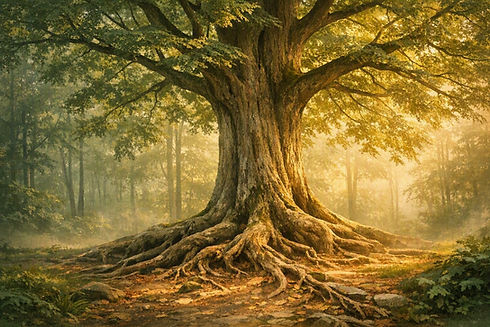
You come to a clearing. In the center stands a tree whose leaves shine like small lanterns. This tree represents your inner steadiness. Some of its leaves are still bright. Some have fallen. Some branches are bare. Yet the tree is whole. It does not measure itself by what remains visible. Its roots are deep, and its life continues below the surface.
Stand near this tree in your imagination. Place your palm against its trunk. Feel its quiet strength. Allow the tree to show you something about your own life. Perhaps there is a responsibility you can approach with less tension. Perhaps there is a comparison you can release. Perhaps there is a boundary you need to honor. Perhaps there is a simple pleasure you have forgotten to receive. Let the message come as a word, a color, a sensation, or a knowing.
Now imagine the tree sending warmth through your hand and into your body. The warmth moves into your wrist, arm, shoulder, chest, belly, hips, legs, and feet. It is not dramatic. It is steady. It reminds you that calm does not always arrive as a sudden wave. Sometimes calm returns as a small ember, protected and patient, glowing quietly in the center of you.
At the base of the tree is a basket woven from golden grass. You may place into this basket anything you are ready to stop carrying alone. Place a worry there. Place a harsh expectation there. Place the need to control what cannot be controlled. Place the habit of rushing past beauty. The basket accepts each offering. The tree knows what to do with it. The earth knows how to transform it.
When the basket feels complete for today, thank the tree. Look once more at the autumn path. Notice that you are not leaving empty-handed. You are carrying a quieter breath, a steadier body, and the memory of belonging. Begin to return to the room or place where you are. Feel your feet. Move your fingers. Open your eyes when you are ready. Let the meditation end slowly, the way daylight fades gradually in autumn.
“In every walk with nature one receives far more than he seeks.” — John Muir
Stress relief grows more effective when it becomes woven into ordinary life. You do not have to wait for a perfect free afternoon. Autumn offers countless small invitations. Watch steam rise from your morning drink near a window. Step outside at dusk and notice the first cool breath of evening. Collect three leaves and arrange them on your table. Take a slow walk after lunch. Look up at migrating birds. Visit a farmers market. Sit under a tree for five minutes without checking your phone. Let the season interrupt the trance of busyness.
Try choosing one autumn cue as your personal reminder to pause. It might be the color orange, the sound of leaves, the smell of cinnamon, the sight of bare branches, or the feeling of putting on a sweater. Each time you encounter that cue, take one conscious breath. This turns the season into a meditation bell. Instead of relying on willpower to remember calm, you let the world remind you.
You can also practice gratitude in a sensory way. Name one autumn color you are grateful for, one sound, one scent, one texture, and one taste. Gratitude becomes more stabilizing when it is specific. “I am grateful for beauty” is lovely, but “I am grateful for the red leaf glowing against the wet sidewalk” brings the body into the experience. Specific gratitude turns attention toward what is real and present, which can soften the grip of abstract worry.
This 7-day plan is designed to help you build a gentle rhythm of outdoor awareness, sensory grounding, and creative visualization. Each day can take as little as ten minutes, though you may stay longer if the practice feels nourishing. Repeat any day as needed, and let the weather, your energy, and your surroundings shape the experience.

Go outside or sit near a window where you can see the season clearly. Take five slow breaths while noticing the temperature of the air. With each inhale, silently say, “I arrive.” With each exhale, say, “I soften.” Let your body understand that this moment does not need to be rushed. For visualization, imagine the autumn air washing through you like a clear stream, carrying away the first layer of tension. Reflection prompt: What changes when I let my breath set the pace?
Affirmation: I let this day meet me softly, one breath at a time, and I allow autumn’s quiet air to remind me that I do not have to hurry back to myself. Reflection: What would it feel like to simply arrive here, breath by breath?
Take a slow walk and let fallen leaves guide your pace. Notice their shapes, colors, and sounds beneath your steps. If your mind starts planning or worrying, return to the sensation of walking. For visualization, imagine each leaf on the ground as a thought that has already landed. You do not need to pick it back up. Reflection prompt: Which thoughts am I ready to stop carrying today?
Affirmation: I walk gently with the falling leaves, allowing each step to loosen what feels heavy and invite a quieter breath. Reflection: What might feel lighter if I let it rest for now?
Find a safe place to sit or stand quietly. Listen to the sounds around you without labeling them as pleasant or unpleasant. Notice birds, wind, distant traffic, footsteps, or silence between sounds. For visualization, imagine every sound as a circle expanding on the surface of a pond, then fading back into stillness. Reflection prompt: Can I allow my thoughts to come and go the same way sounds do?
Affirmation: I listen with a tender heart, trusting the soft spaces between sounds to hold me in stillness and ease. Reflection: What quiet space within me is asking to be heard?
Choose one worry, pressure, or expectation you are willing to loosen. Hold a leaf if one is available, or imagine one in your palm. Breathe in and acknowledge what you have been carrying. Breathe out and picture the leaf drifting gently to the earth. For visualization, see the soil receiving the leaf and slowly transforming it into nourishment. Reflection prompt: What might become possible if I release even a small part of this burden?
Affirmation: I allow what feels ready to soften to drift into the patient care of the earth. Reflection: What small burden can I meet with tenderness today?
Spend several minutes moving through the five senses. Name five things you see, four things you hear, three things you feel, two things you smell, and one thing you can taste or savor. For visualization, imagine each sense as a doorway opening into the present moment. Reflection prompt: Which sense helps me feel most grounded right now?
Affirmation: I open slowly to the gifts of this season, receiving color, scent, sound, texture, and taste as gentle reminders that peace can be simple. Reflection: Which small sensory detail feels soothing to me today?
Stand near a tree, sit beneath one, or imagine one if you are indoors. Notice the trunk, branches, roots, and changing leaves. Let the tree remind you that steadiness can exist alongside transition. For visualization, picture roots growing from the soles of your feet into the earth, giving your body a sense of support. Reflection prompt: Where in my life do I need steadiness more than speed?
Affirmation: I am allowed to rest in my roots, grounded and unforced, while the season changes around me at its own gentle pace. Reflection: What quiet strength can I notice in myself today?
Return to a place you visited earlier in the week or choose a new spot that feels welcoming. Take a few breaths and remember the practices you explored: arriving, walking, listening, releasing, sensing, and resting. For visualization, imagine gathering the week’s moments of quiet into a small lantern of golden light at your heart. Let that light accompany you into the days ahead. Reflection prompt: What simple autumn practice do I want to continue beyond this week?
Affirmation: I carry this week’s stillness gently within me, like a small warm light, and I may return to it whenever I need steadiness. Reflection: How can I let this small light guide one tender choice today?
Autumn does not ask us to become someone else. It asks us to notice what is changing and to meet that change with tenderness. It reminds us that slowing down is not the same as giving up, that release is not the same as loss, and that rest is not an interruption of life but part of its rhythm. When we walk among falling leaves, breathe cool air, listen to branches, and let color enter our tired minds, we remember that peace is not always found by escaping the world. Sometimes it is found by returning to it more fully.
The next time stress gathers in your shoulders or thoughts begin circling too tightly, step toward autumn in whatever way you can. Open a window. Touch a leaf. Watch the light change. Imagine a golden leaf carrying one small burden to the earth. Let your breath follow it down. Let your body remember that you belong to seasons, not machines; to cycles, not constant output; to a living world that knows how to change without losing its essence.
May this autumn bring you moments of quiet attention. May the trees remind you that letting go can be graceful. May the earth remind you that what falls can nourish what comes next. And may your own heart, like the season itself, find beauty not only in holding on, but in softening, releasing, and beginning again.
Comments